"MCF Friendly Squirrels" and "In His Eye" by William 'Cowboy' Wright
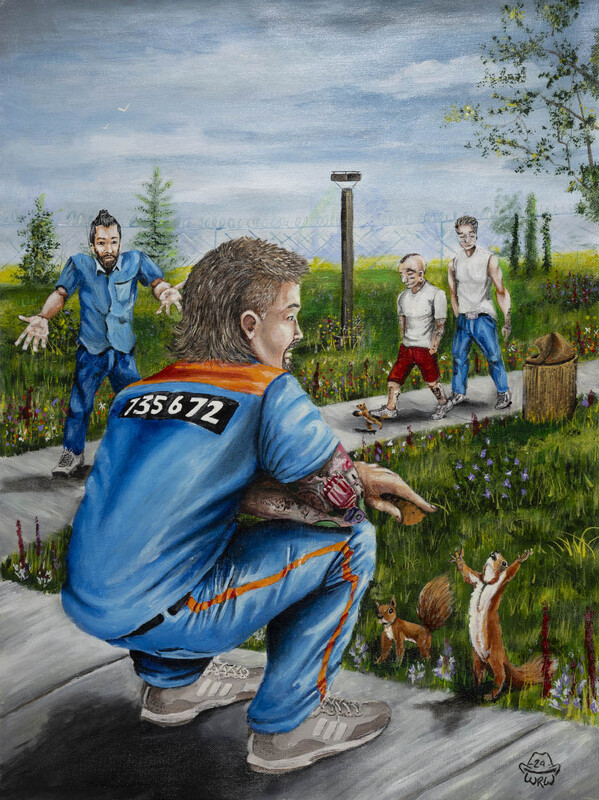
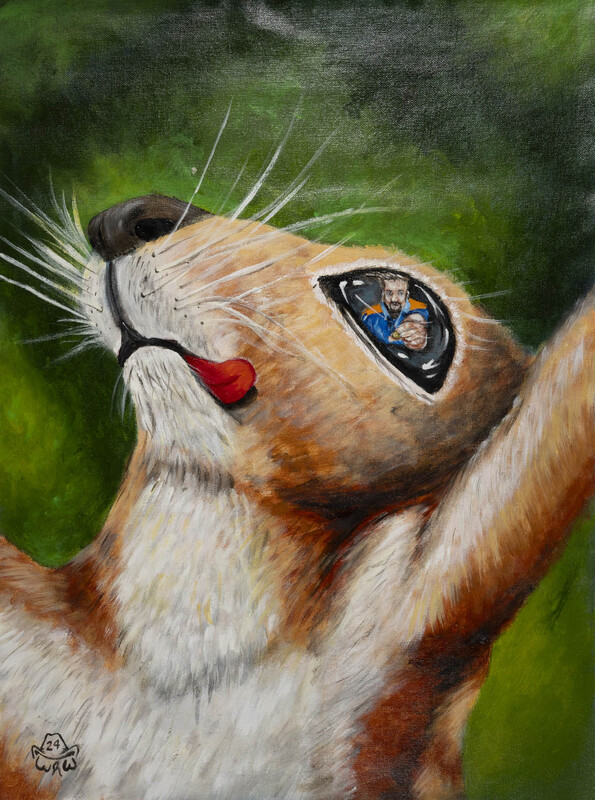
MCF Friendly Squirrels and In His Eye by William ‘Cowboy’ Wright resist carceral norms through artmaking as a social practice. These two pieces were made at Muskegon Correctional Facility and were featured in the Prison Creative Arts Project’s 29th Annual Exhibition of Artists in Michigan Prisons. MCF Friendly Squirrels is an acrylic painting featuring the artist, Cowboy, in the foreground feeding two squirrels in the prison yard. The squirrels are perched in a plot of grass and wildflowers surrounded by sidewalk paths. In the background, the viewer can see three other figures walking in the yard approaching Cowboy. In His Eye displays the same scene from the squirrel’s perspective. The viewer sees a closeup squirrel portrait, its tongue out, anxiously waiting for Cowboy’s snacks. In the squirrel’s eye is Cowboy’s reflection, handing the squirrel his long-awaited treat.
Cowboy’s artistic cohort and community inspire and motivate one another, demonstrating artmaking as a social practice within prison. The background of MCF Friendly Squirrels depicts Cowboy’s fellow artists that he creates art with inside. The artists call themselves ‘Studio 230’, named after their cell number. One of the artists in Studio 230, featured in Cowboy’s painting, is Jimmy. In an audio recorded interview, Cowboy discusses In his Eye, crediting Jimmy with the idea. He states, “I would’ve never have thought to do that if it had not been for him” (Wright, 2024). This artistic community collaboration disrupts carceral norms; prison is not a place for connection, or what the facilities call ‘overfamiliarity’. The group reclaims the literal space of the cell by repurposing their cell number to name their artistic community. The prison environment works to isolate, yet artists resist these norms in order to further their craft.
Another artist in Studio 230 is Nino Tanzini, a fellow PCAP participant. In an audio interview regarding the exhibit, Tanzini discusses his artistic practice and experience as a member of Studio 230. He states, “Being able to be around Cowboy for eight to twelve hours painting, the growth in what I want to do and where I want to go has excelled because of how much we do” (Tanzini, 2024). Later, Tanzini discusses the importance of art in his life in prison, stating that Studio 24 works to “not let prison hold us back from expressing [ourselves]” (Tanzini, 2024). Studio 230 inherently disrupts carcerality. Members of Studio 230 wield their prison time to disrupt punitive practices, creating art in prison spaces designed to isolate and dehumanize those inside. Friendship and connection in prison is viewed as a threat; some prisons will even send incarcerated individuals to other facilities in order to separate friends from one another. Connection is weaponized in prison; yet, these artists join forces to motivate, inspire, and create with one another. Studio 230 demonstrates how art works as a social practice in prison, resisting carcerality through connection.