Looking Forward by Ryan G.
“Imagining the impossible is what people have been doing in the struggle for liberation… artists have helped people kind of open their imaginations to what can be done…art enables your mind and heart to open, to sense, even if you can’t quite explain the possibilities for different configurations of human and resource interaction.” - Ruth Wilson Gilmore
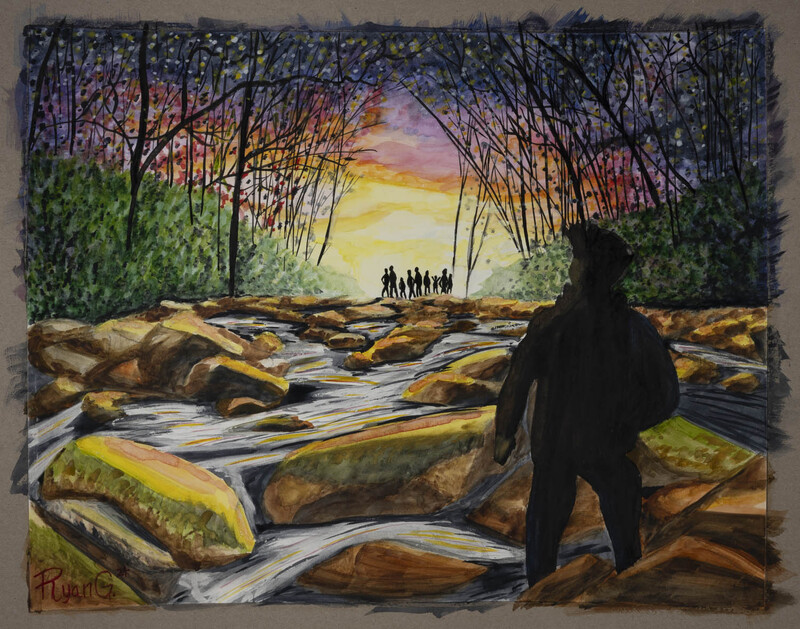
Ryan G’s piece Looking Forward utilizes future imaginings as liberation. His painting creates futurity outside of incarceration, engaging instead in nature and community. Ryan G’s watercolor painting depicts himself as a figure in the foreground, gazing towards a throng of people far in the background. Separating the solo figure from the group is a rocky stream, surrounded by trees, a sunset backlighting the image. Ryan utilizes art in order to envision a future out of reach, contrasting carceral imagery with notions of peace, nature, and community. Ryan’s piece depicts how artistic reimaginings of the obsolescence of carceral spaces work as abolition.
Ryan G is able to achieve restored humanity through artmaking in community. Looking Forward was featured in the 29th Annual Exhibition of Art in Michigan Prisons; Ryan has been submitting to the PCAP art show for the past 20 years. In Ryan’s artist statement, he says that he looks forward to the PCAP exhibition every year: “I am grateful for restored humanity with every interaction and every piece of art… I receive a little more of my humanness and share it with others” (Ryan, 2024). Ryan resists carceral logics by creating art in a punitive environment, and in doing so, builds relationships rooted in artmaking and resistance. His statement of gratitude for ‘restored humanity with every interaction and every piece of art’ refers to the conversations had between inside and outside artists during the Prison Creative Arts Project selection trips, in which PCAP staff, students, and faculty visit prisons in Michigan to meet artists and talk to them about their art. Members of PCAP are not only at these facilities to curate for the exhibit; it is our job to empower artists to keep creating, motivate artists to go out of their comfort zones within their artistic practice, and most of all, create genuine connections. This inside-outside community bolsters creativity and, as Ryan states, serves to restore incarcerated folks’ humanity. Artmaking works as a social practice in order to amplify incarcerated artists’ voices. Ryan shares his humanity with others by entrusting PCAP with his art; these pieces work as a means of communication to those outside of prisons, being displayed in a public space for guests to interact with, ponder, and digest. Alongside the physical exhibition, guests are able to read artist statements, listen to audio interviews, and write in the guest book. These points of interaction allow for delayed social function between artist and viewer, further empowering artists like Ryan. Ryan is able to connect and create community without being physically present, by expressing his sentiments through artmaking. Art is able to cultivate community; amongst the dehumanizing and isolating environment of prison, creating and sharing gives artists inside hope.
Ryan G’s piece Looking Forward utilizes images of nature as a form of escapism. In his artist statement, Ryan states that nature is “his favorite thing to think of… As I am unable to physically experience nature, I create it in my mind and then on paper” (Ryan, 2024). Ryan uses nature as a visual language to express something deeper than simply scenery. The natural environment contrasts carceral geographies, offering a peaceful escape for artists to imagine life past prison fences. The vibrant colors featured in the piece also contrast carceral aesthetics of bleak tiles and sterile white walls. Ryan is able to create new atmospheres outside of confinement; although he is unable to experience it in a tangible way, his abolitionist imagination allows him to create these images as a way of inherent resistance.
Looking Forward envisions a future outside prison walls. Utilizing notions of abolition geography, Ryan is able to reclaim autonomy within a punitive system. ‘Abolition geography’ is a term coined by Ruth Wilson Gilmore, an activist and scholar. She writes about the reimagining of an abolitionist future. Her writing focuses on the relevance of abolition and the power of conceiving a future without prisons; her work explores why and how these abolitionist visions are integral and radical. In her book of essays entitled Abolition Geography: Essays Toward Liberation, Gilmore describes abolition geography as “how and to what end people make freedom provisionally, imperatively, as they imagine home against the disintegrating grind of partition and re-partition through which racial capitalism perpetuates the own meaning of its valorization.” (Gilmore, 365) She states that abolition geography “elaborates the spatial,” centering agency that isn’t constrained by structure. Abolition geography requires the conceptualization of societal structures outside of punitivity. It encompasses imagination as the work of liberation. It conceptualizes the future as resistance. Ryan G’s piece radically reimagines place and space, depicting a future filled with connections to nature, community and self. There are visual symbols throughout the piece that resist carceral norms: the solo traveler traversing the babbling brook, the expansive nature encompassing the canvas, and the community awaiting the traveler’s arrival. The freedom depicted in this painting envisions a future outside of the sterile, inhumane prison environment. Ryan G’s painting resists confinement through these connections; the natural environment, human connection, and individual autonomy all challenge notions of punitivity. Looking Forward envisions an environment and geography that doesn’t currently exist; however, it is this reimagination of futurity that works to liberate those who are incarcerated.