Never Finished by anonymous
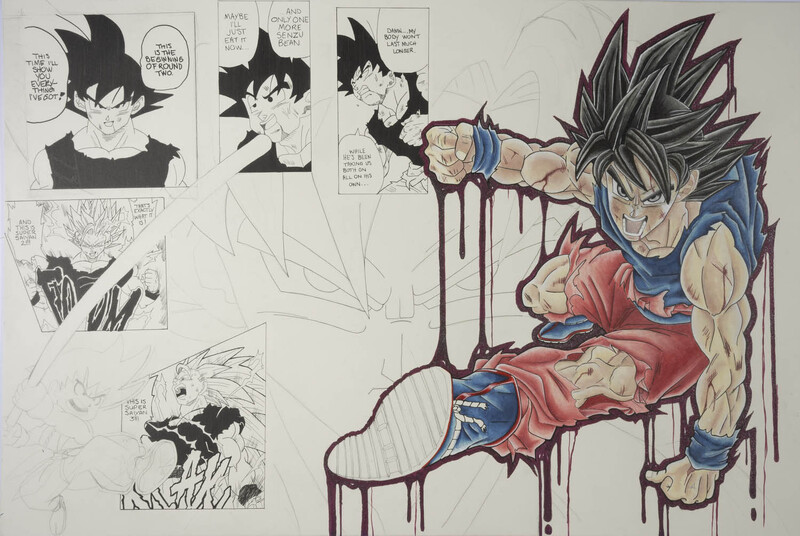
Never Finished demonstrates how art works as a tool to process intense emotions within carceral spaces. Never Finished is a piece submitted to the Annual Exhibition in 2025. It was made in FCI Milan, Michigan’s sole federal prison facility. The piece was submitted anonymously, a regulation forced upon artists by the federal facility. The piece features Goku, a protagonist from the Dragon Ball anime series. Goku’s figure is featured in full, his face expressing great strength, focus, and ferocity, muscles flexing and fist clenched. While Goku’s colorful, expressive character takes up the right half of the page, the other half is plain — incomplete black and white comics and pencil outlines fill the rest of the page.
According to the artist’s statement, the piece was deliberately left unfinished. The anonymous artist writes that the last time he was working on the piece, his friend was watching and supporting him. His friend was unauthorized to be in the area and was removed from the room by correctional officers. Two weeks later, this friend died by suicide. The artist had a hard time revisiting the piece after his loss, and during his time away from the piece, the creator of Dragon Ball, Akira Toriyama, died suddenly in March of 2024. The artist then decided to stop working on his piece; he felt that it no longer honored the lives of his friend nor Goku’s creator. Later, the artist’s brother died by suicide. Reflecting on his incredible grief and loss, the artist stated:
I, like Goku, must push through every adversity, constantly pursuing higher levels of strength and fortitude to endure. With every new level comes more and greater difficulties. All of us, like Goku, have the strength to endure. Everytime! So, like Goku, my fight is unfinished. My power limit is unknown. My work is unfinished because perfection is a journey not a destination. (anonymous, 2024)
Never Finished is reflective of the artist’s emotional journey through grief while in prison. Prison is not an environment that promotes emotional processing, healing, or anything of the sort. Yet, the artist was able not only to utilize art as a means of emotional processing, but to reflect positively on his journey through life. There is an intentionality behind the artist’s message: the artist works to humanize himself and other artists inside by openly expressing the ways in which hardship impacts those inside, just as it affects those in the free world. The artist purposefully left his piece unfinished in order to visualize his ongoing grieving process and represent the evolution of his art.
Never Finished contrasts artistic norms, purposefully being left unfinished in order to convey the artist’s journey through grief. In art, there are notions of completion and cohesion.
In the early 1920s, German psychologists created Gestalt Principles of Design, which outline guidelines for designers to create cohesion in their pieces (IXDF). These principles are still taught today in art schools to further an artist’s understanding of completion in a piece of art. Formal art settings prioritize a sense of unity and harmony within creativity; yet, this artist utilizes incompletion as a means of expression. The artist challenges these artistic norms, leaving the piece purposefully incomplete, creating his own visual language. The artist demonstrates his deliberate choice to leave the piece’s background incomplete, emphasized through his title choice, Never Finished.
The artist works to reclaim space and time within prison through artmaking, dedicating it to the grieving and honoring of his loved ones. At first glance, the piece feels entertaining, comical. What began as an amusing subject turned into a moment of reckoning. The act of artmaking in prison inherently resists oppressive carceral norms. Furthermore, self expression within art resists carcerality, utilizing art as a means of both emotional processing and emotional relatability for the artist and audience alike. The piece also exhibits artmaking as a social practice: the artist is able to connect with those he has lost both within and outside of prison through his artistry.