Portrait Painting from Life by Raybay o Say
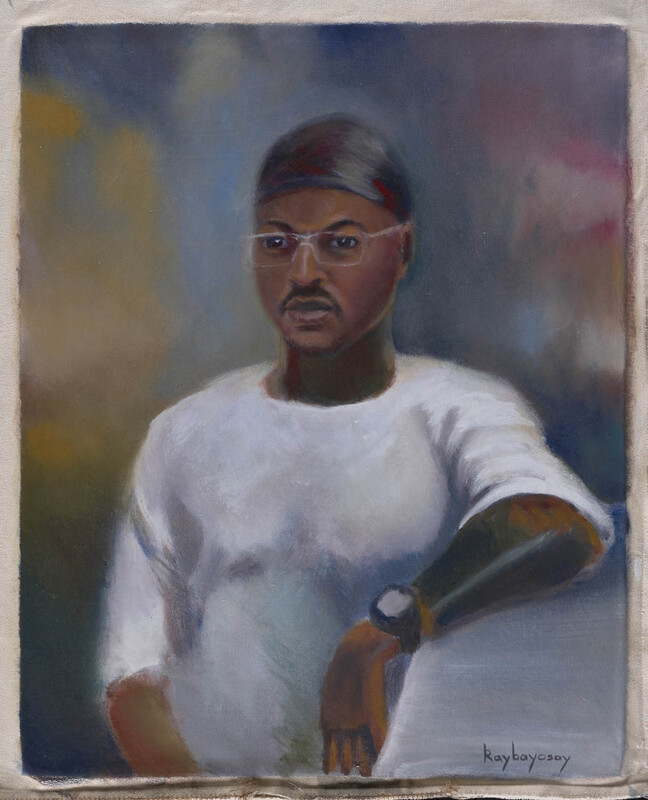
Raybay o Say’s painting Portrait Painting From Life demonstrates how artmaking as a social practice works to liberate both subject and artist to resist oppression in carceral spaces. Portrait Painting From Life is a piece featured in the Prison Creative Arts Project’s 29th Annual Exhibition of Artists in Michigan Prisons [2025]. This acrylic painting features a still life portrait set in prison. A glowing, ambient background surrounds the subject, a solemn man whose eyes meet the viewer. This portrait was painted by Raybay o Say, an incarcerated artist at Kinross Correctional Facility who has submitted his art to PCAP since 2007. According to Raybay o Say’s artist statement, the piece was painted from life and took approximately 3 hours. The subject of the painting is Willie Anderson, a fellow incarcerated artist who has submitted to the PCAP exhibition since 2018. For last year’s exhibition, the two artists submitted paintings of one another; Anderson painted Raybay o Say based on an image of him in his youth while Raybay o Say painted Anderson from life.
Portraiture in prison inherently contradicts carceral norms. In a system whose purpose is to dehumanize and isolate, incarcerated artists resist this oppression through their artmaking practices, creating meaningful messages and connection through their pieces. Portraiture as an art form explores connection, encapsulating the relationality between subject and artist. Portraiture gives artists the ability to represent their subjects in a way they see fit; in prison, this is rare. Those who are incarcerated are constantly defined by their past; portraiture in prison opposes these notions, giving incarcerated artists the autonomy to express themselves/their subjects in a way that is reflective of their own perspectives.
Raybay o Say’s choice of background also contrasts penal space. An aspect of the piece that should be noted is its glowing background. This painting was presumably created within the dayroom, a communal space within the facility for recreational activities. Prison interiors are dilapidated; the atmosphere is bleak and sterile with little color. Yet, there is something ethereal and magical about the fusion of muted, luminous colors in the painting. There is intentionality in this background: Raybay o Say erases the institution within his piece, focusing rather on his relationship to the subject, capturing the reverence of Anderson’s being without the grim aesthetics of prison. Raybay o Say’s blend of realism and whimsy demonstrates how artmaking creates an escape from real environments, particularly the oppressive nature of carceral spaces.
Art within prison walls transforms the relationship between carcerality and time, instead reclaiming time as a resource that can be used for creativity, self expression, and hope. In Raybay O Say’s portrait, time is being reframed; in a carceral space where time is a mode of punishment, the two artists utilized the three hours it took to complete this painting to hone in on their craft and engage in mutual artistry and learning. In the painting, you see that subject Willie Anderson is wearing a watch, a particularly pronounced object amongst the otherwise itemless piece. Portraits often include small details to illustrate the subject’s personality or circumstance; although the artist erases indicators of prison, he preserves the role of time. This symbolism works to redefine time within confinement as something that isn’t punitive but artistic and communal.
Raybay o Say’s Portrait Painting From Life challenges the viewer’s perception of those incarcerated. Still life portraits are incredibly rare in prison; this is due to the lack of intimacy between incarcerated folks as well as the lack of opportunity to engage in artmaking as a social practice. Connection is limited in carceral spaces; people are labelled by their prison ID numbers, secluded to their bunks, forbidden from any form of physical touch. Connection with another inmate is heavily stigmatized. Portrait Painting From Life is unique in that subject Willie Anderson sat posing for Raybay o Say for three hours; three hours of time and space dedicated to art and to the connection between the two artists. The use of artmaking as a social practice not only creates space for self expression, but validates humanity through the resistance of oppression.