What Your Taxes Go To by Cory Willet
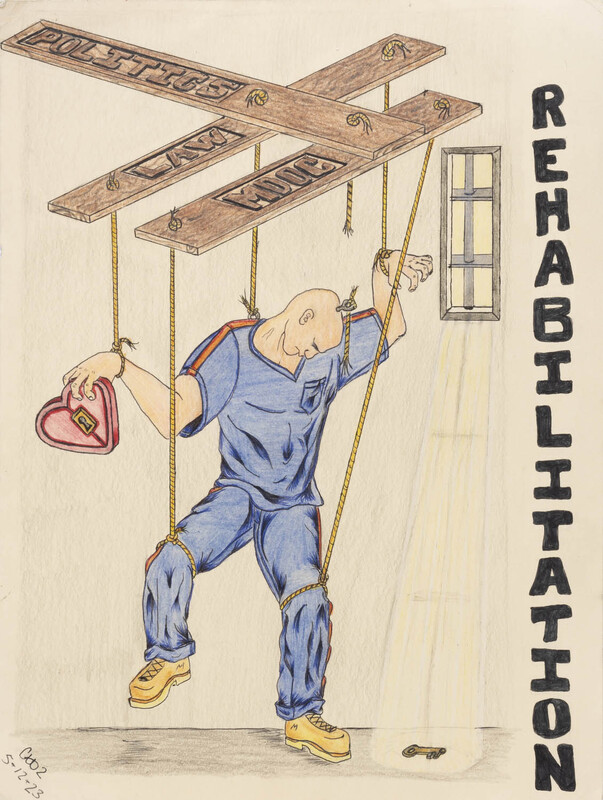
In What Your Taxes Go To, artist Cory Willett utilizes visual language in order to communicate the brutal conditions of prison, addressing the flawed punitive notion of ‘rehabilitation.’ The colored pencil drawing features a marionette puppet figure in a prison uniform, suspended with string to several control bars. Each wood plank that creates the control bar features its own term: politics, law, and MDOC. The hand of the puppet figure holds a locked heart-shaped box. The key is on the floor, out of reach, illuminated by light glistening through the slim, barred window. On the right, the term ‘rehabilitation’ stands vertically in all caps. Willett is able to communicate his experiences in prison through symbolism. Together, these components invoke feelings of confinement, critiquing the carceral state through artistic interpretation. Willett utilizes visual imagery to convey the exploitative and abusive nature of prison.
What Your Taxes Go To depicts an incarcerated figure as a marionette, suggesting the manipulative and exploitative nature of prison. The planks and strings that control the incarcerated figure represent those in power who utilize prison time and labor for their own benefit. These systems coalesce in pursuit of the exploitation of those incarcerated, whether it be disproportionately incarcerating poor people of color to keep prisons profitable, paying those incarcerated $0.50 an hour for their labor, or increasing prices on necessities and supplies inside. The only string that has been severed is the one holding the figure’s head, which according to Willett, “allows his head to drop in perpetual and crippling shame” (Willett, 2024). Willet quite literally visually depicts structural oppression using symbolism through visual language.
The locked box, light, and key explore themes of longing in prison. The heart shaped box in the figure’s hand is “filled with all he holds dear,” according to Willett. He is unable to access what is inside, his hands bound by the marionette strings, the key to the box just out of reach. The light from the window that engulfs the key symbolizes the figure’s hope for what is outside those prison walls. The figure is stuck in perpetual waiting, representing the longing of those behind bars for a future with their family, community, and autonomy. Those inside are stripped of their humanity and connection, left dangling at the will of the state.
The right side of the page features the word ‘rehabilitation’ in large bold lettering, emphasizing the absurdity of the term in the context of prison. Rehabilitation is typically defined as an act of restoration, a form of recovery, repairing something to its former condition. This term is often used to describe the goal of incarceration as well. Yet, prisons contain harsh conditions, poorly implemented programs, and a severe reliance on punishment. Prisons do not prepare those inside for life after release; there are significant barriers to housing, employment, and resources for formerly incarcerated folks. Rehabilitation emphasizes the notion of returning something back to its original form, yet this original form is incredibly flawed. Incarceration continues the systemic cycle of poverty, racism, and incarceration, none of which align with the notions of ‘rehabilitation’. Willett utilizes the term to invoke critical thought in the mind of the viewer, providing intel into the false notion of restoration in prison. Prisons function under the illegitimate guise of rehabilitation; Willett exposes the fallacy of ‘rehabilitation’ within the criminal justice system through his use of text in his piece.
What Your Taxes Go To invokes inside-outside communication in order to critique the criminal justice system. In Willett’s artist statement, he says, “We need, and want, help”(Willett, 2024). Willett utilizes the Prison Creative Arts Project Annual Exhibition as a platform to connect to audiences beyond prison walls, imploring viewers to look critically at the systems they are complicit in. Where Your Taxes Go To functions as a vehicle for critique, challenging dominant narratives. The piece affirms and validates the humanity of the artist, with the exhibition providing a means for communication between those inside and outside prison walls. Willett utilizes art as a means of critique, revealing the corrupt nature of the criminal justice system through visual imagery.