Political Economy
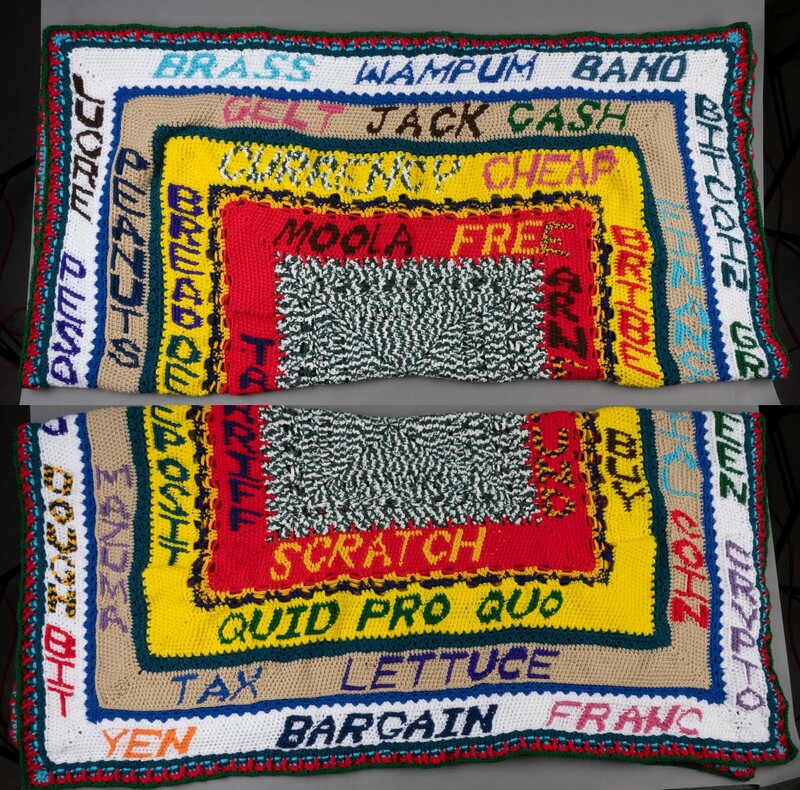
"Financial Blanket," Thomas Wingard
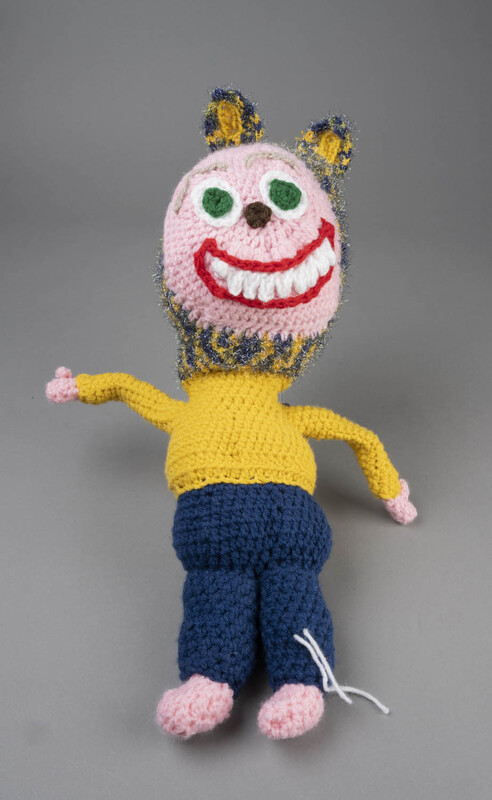
Incarcerated people find themselves at the nexus of two of the most powerful structures in American society–criminal justice and capitalism. These structures are deeply historically intertwined; they mutually reproduce and reinforce systems of exploitation, inequality, and violence. The artists featured here confront this political economy in a variety of ways, some through political critique, others through satire, and others by demonstrating ways to survive that subvert these structures themselves.
Thomas Wingard’s Financial Blanket satirizes the ways that capitalism and consumerism pervade our culture across prison walls and across international borders. In this original crochet design, Wingard depicts words for money surrounding a central square made of green and white variegated yarn meant to mimic the appearance of American paper money. He includes words in English and in other languages–currency, peso, yen–as well as euphemisms–bread, moola, cash. Alongside these words are even more political terms–bribe, bitcoin, and quid pro quo. Wingard’s choice to make a blanket begs the question, is this what you want to be wrapped in?
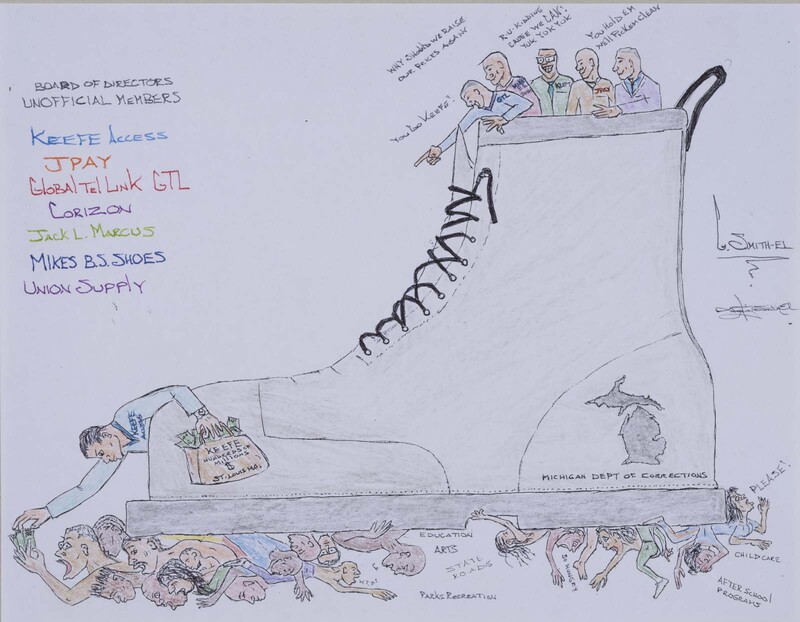
Other artists draw attention to the privatization of Michigan prisons and the systems of labor and capital extraction that incarcerated people endure. G. Smith-El’s Foot on Back levels a trenchant critique of systems of power that prioritize extracting resources rather than providing support and services to communities in need. Smith-El portrays the Michigan Department of Corrections as a metaphorical boot that crushes a mass of incarcerated people. The boot also stamps out social services, including childcare, parks and recreation, and education. At the top of the boot are what Smith-El terms the unofficial board members of the MDOC–corporations that provide services to incarcerated people including JPay (email), GTL (phone calls), and Keefe Access (money management). These corporations make millions of dollars in profits each year while incarcerated people typically earn less than two dollars a week.
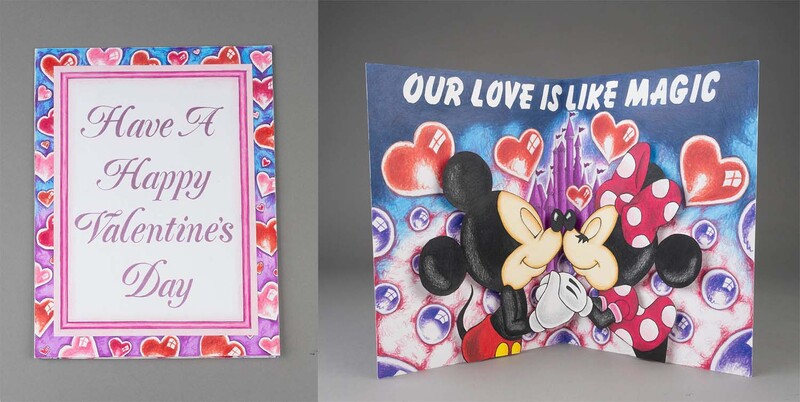
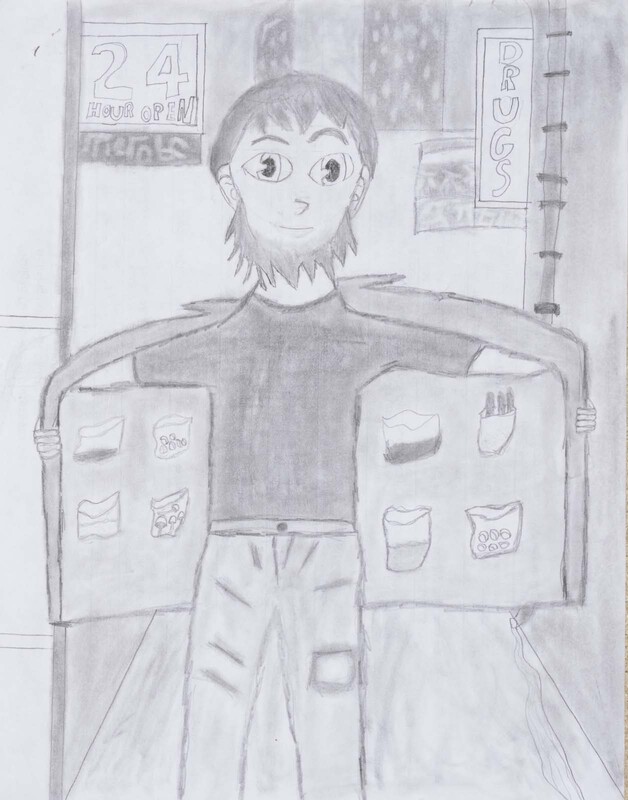
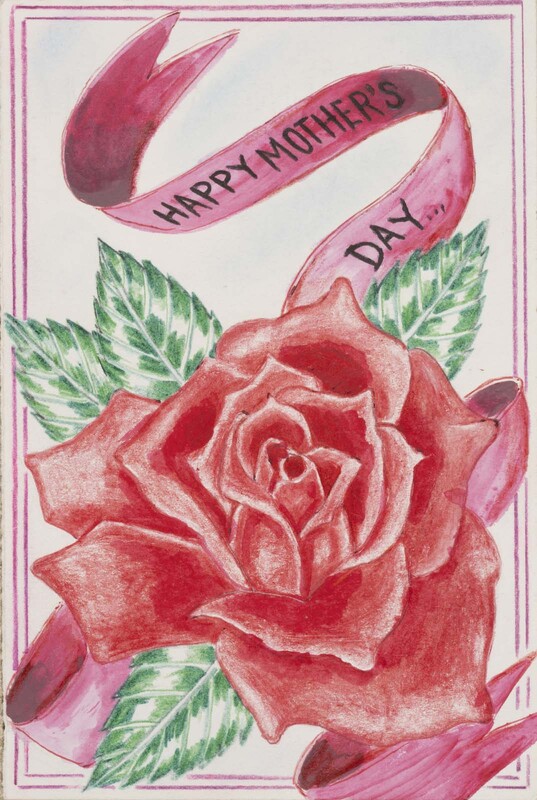
Despite the significant extractive power of the political economy, incarcerated people find ways to subvert it. Disney Valentines Card, by an anonymous artist at FCI Milan, is a characteristic example of a greeting card, a form of artmaking that proliferates inside prison. There is a high demand inside prison for cards that incarcerated people send to their loved ones and many artists sell cards to support themselves. Twisted Wizard’s Life in the City depicts another kind of survival economy, the illicit drug market. The figure in the foreground stands in front of a legitimate drugstore while he offers illicit drugs for sale. The composition emphasizes the exclusion of many marginalized communities from the formal economy and the methods of survival that many feel forced to turn to.
Together these artists ask us to question the political economy that structures our society and the many forms of inequality and exploitation that it reproduces. It is one of the most important functions of art–to defamiliarize and denaturalize what we have come to take for granted.
By: Nora Krinitsky